546 - bombShield(int a, int script)
Sets the bomb invulnerability flag (a=0 false, a=1 true), the caller's ANM script will change to script when a bomb is active.
611 - etEx(int etId, int async, int type, float a, float b)
Adds bullet transformation to bullet manager etId, Transformation of flag type determines the specific behaviour of the bullet. Documentation can be found here.
BulletEffectType-67108864 - etExDelay(string et, string isAsync, string time)
Hide the bullet for time frames. During this time, it will not move, will be invisible and won't have a hitbox. If used as a first transformation, can be used to delay when the bullet actually appears.
6 - isDelayedSpawn
While this flag is set, the bullet will be invisible and not have a hitbox. This flag is cleared once the delay timer ends.
4 - short_timer
Integer value between -1 and 15 inclusive (by default -1). If non-negative, shooters using short_timer shoot their bullets and timer increments by 1 per frame until 15 is reached. Once 15, timer reset to -1 or 0 depending on Z key state.
5 - long_timer
Integer value between -1 and 120 inclusive (by default -1). If non-negative, shooters using long_timer shoot their bullets and timer increments by 1 per frame until 120 is reached. Once 120, timer reset to -1 or 0 depending on Z key state.
91 - floatTime(int slot, float var, int time, int mode, float start, float final)
In time frames using mode mode, variable var changes from start to final. slot is used to set the slot to be used by this ins, every enemy has 8 slots.
-9980 - F1
Local float variable, inherited by spawned enemies.
-9984 - I1
Local integer variable, inherited by spawned enemies.
-9989 - ANGLE_PLAYER
Angle from the enemy to the player.
-9962 - BOSS_Y
Final Y position of the boss.
-9990 - PLAYER_Y
Player's Y position.
-9963 - BOSS_X
Final X position of the boss.
-9991 - PLAYER_X
Player's X position.
81 - circlePos(float varX, float varY, float angle, float radius)
Performs following operation: varX = cos(angle) * radius and varY = cos(angle) * radius
-9981 - F0
Local float variable, inherited by spawned enemies.
300 - enmCreate(string sub, float x, float y, int hp, int score, int item)
Creates an enemy using subroutine sub at coordinates (x, y) (relative to position of the parent), health of created enemy is hp, score bonus is score and item drop is item.
601 - etOn(int etId)
Shoots bullet(s) using properties from bullet manager etId.
23 - wait(int time)
Stops sub execution for time frames.
1 - delete()
Returns to the top of current call stack.
2 - GAME_SPEED
The value controls by how much faster the game speed is run. This variable is often set to a number between 0 and 1. This value is often changed when a (final) boss dies or when a photo is taken. Its default value is 1.
-9985 - I0
Local integer variable, inherited by spawned enemies.
-9983 - I2
Local integer variable, inherited by spawned enemies.
-9982 - I3
Local integer variable, inherited by spawned enemies.
-9954 - ENEMY_HP
Enemy's current HP.
3 - goheiExists
A flag that determines if a gohei exists on-screen or not. Flag is set to true by active gohei. Flag is set to false if gohei goes off-screen or is despawning.
-9926 - GI0
Global integer value. Value is initialised to 0 on stage load but not on stage reset.
-9925 - GI1
Global integer value. Value is initialised to 0 on stage load but not on stage reset.
-9924 - GI2
Global integer value. Value is initialised to 0 on stage load but not on stage reset.
-9923 - GI3
Global integer value. Value is initialised to 0 on stage load but not on stage reset.
17 - distortion(int a)
Triggers distortion effects on the edge of the screen. The meaning of the argument is not entirely clear. SA uses a value of 1 to create distortion at the bottom of the screen, while UFO uses this same value to create distortion at the top.
539 - spell3(int id, int timeRate, int unused, string name)
Declares a spell-card with id id and name unused. The ID passed to the spell-creating function is id + difficulty - 2 (with easy=0, normal=1, ..., overdrive=5). timeRate determines how much time the spell circle takes to shrink (in frames), as well as how fast the spell bonus decreases.
514 - setInterrupt(int slot, int hp, int duration, string subroutine)
Sets an interrupt on slot slot. Once caller's HP reaches hp or duration frames have passed since this instruction was called, the caller will terminate all subroutines it's currently running and execute subroutine subroutine.
270 - enmCreate270(string sub, float x, float y, int hp, int score, int item)
Creates an enemy using subroutine sub at coordinates (x, y) (relative to position of the stage background camera), health of created enemy is hp, score bonus is score and item drop is item.
Hourai Jewel Bounce
- Versions:
 1.00 - 1.00a - 1.00b - 1.00c -
  1.00d
1.00d - Difficulty: Easy - Normal - Hard - Lunatic -

Extra-Last Word - Mode: Main game - Practice mode - Spell Practice
- Shottype: Border Team - Magic Team - Ghost Team - Scarlet Team - Reimu - Yukari - Marisa - Alice - Youmu - Yuyuko - Sakuya - Remilia
On Kaguya's 5th spell-card, there is a chance that a bullet from below bounces upward. This comes from the initial wave the familiars shoot.
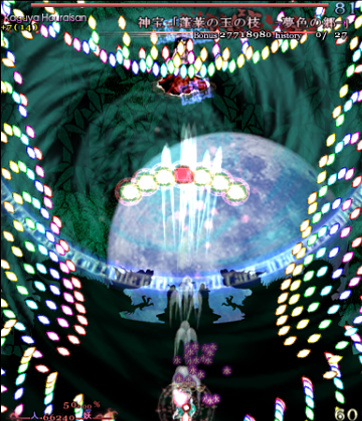
To get this, you usually have to be unlucky. However, since there is no RNG involved there are normalised set-ups one could use to get this bug.
In order to understand this phenomenon, we need to take a look at the bullet's transformation properties.
Bullet transformations or transformations are special properties that are given to a bullet. The bullet could for example be immune against bombs, or the bullet could change color, or a certain sound could play when the bullet is first shot.
In the context of this glitch, there are two relevant bullet transformations at play:
- Transformation 2048 - bounce on all walls except bottom
- Transformation 128 - sets angle towards player
The bullets that use this transformation are shot by the first wave of the familiar enemies.
The bullet transformations are applied one after the other in a specific sequence. The sequence in which the bullet transformations are applied on this attack are as follows:
Note that transformation 16384 is not relevant for the bug in this case.
A bullet is considered to be Out of Bounds or OoB from below if the bullet's position meets the criteria y > 448 + (sprite_y / 2). The rice bullets have a sprite of 16 by 16, so that means the bullet is out of bounds if y > 456.
On every game frame, every bullet on-screen executes a certain sequence of code. The sequence (in short) goes as follows:
- The game checks if the bullet has an active transformation.
- The game executes the relevant code tied to the active transformation.
- The game updates the bullet's angle and position accordingly.
- The game checks if the bullet is OoB.
Below is a more extensive explanation of the order of events written in pseudo-code.
if (no transform active) {
    activate next transform in list;
    reset tr_timer to 0;
}
if (transform 128 active) {
    if (tr_timer >= delay_time) {
        change bullet angle to aim towards player;
        deactivate this transform;
    }
    else {
        tr_timer += 1;
    }
}
if (transform 1024 or 2048 active) {
    if (bullet out of bounds) {
        if (transform == 2048 && y > 456) {
            don't change bullet angle;
        }
        else {
            change bullet angle;
        }
        deactivate this transform;
    }
}

update bullet position according to speed and angle;

if (bullet out of bounds) {
    if (transform 128, 1024 or 2048 active) {
        oob_timer += 1;
    }
    else if (oob_timer > 0) {
        oob_timer -= 1;
    }
    else {
        delete this bullet;
    }
}
else {
    oob_timer = 0;
}
A few notes:
- Everything that happens in a frame that is not relevant to this has been left out.
tr_timeris a timer that counts the amount of frames a transform has been active.delay_timein transform 128 refers to a value set in the etEx ECL instruction. In this case, the value is equal to 1.oob_timeris a timer that prevents the bullet from being deleted out of bounds if it is nonzero.
- The bullet is shot. Transformation 2048 is active.
- After some time, the bullet reaches one frame before it is out of bounds.
- The next frame the bullet's position updates and it is now OoB going downward. However, since a transformation is active a counter
oob_timeris increased by 1. The bullet isn't deleted. - The next frame transformation 2048 is still active. The bullet meets the condition y > 456. This results in the bullet not changing its angle. The transformation is then deactivated, meaning there's no transformation on the bullet. The bullet's position is updated (it still goes downward). The bullet is OoB going downward but
oob_timeris equal to 1, sooob_timerdecreases by 1 and now has a value of 0. - The next frame transform 128 is activated, setting
tr_timerto 0. Sincetr_timer >= delay_timeis false (0 >= 1 with the value 1 being the 4th parameter of the etEx instruction),tr_timerincreases by 1. The bullet is still OoB still going downward. Transformation 128 is active, sooob_timerincreases by 1. - The next frame transformation 128 is still active, This time, the condition
tr_timer >= delay_timeis met. The bullet's angle changes to be toward the player. The bullet no longer has an active transformation. The bullet's position updates to go upwards. The bullet is still OoB butoob_timeris equal to 1, sooob_timerdecreases by 1 and now has a value of 0. - The next frame transformation 16384 is applied. The bullet's position updates. However, this time the bullet no longer is OoB. The bullet has successfully done the bounce.
Below is a simple diagram of the explanation. Since the speed of the bullet is constant, the length of the vectors are the same.
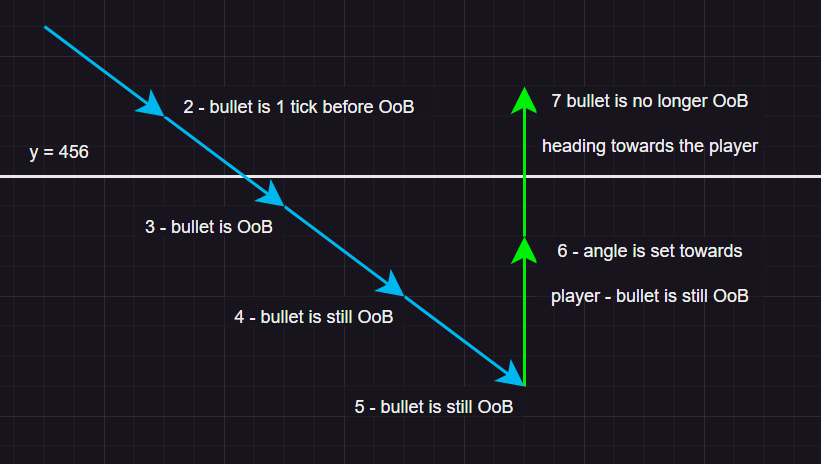
However, in this diagram the bullet is coming at a very skew angle from y = 456, and the bullet is perpendicular to y = 456 once it is aimed towards the player. While this is achievable in-game (by moving the player character to be above a bottom corner), this is not what is happening in the initial image.
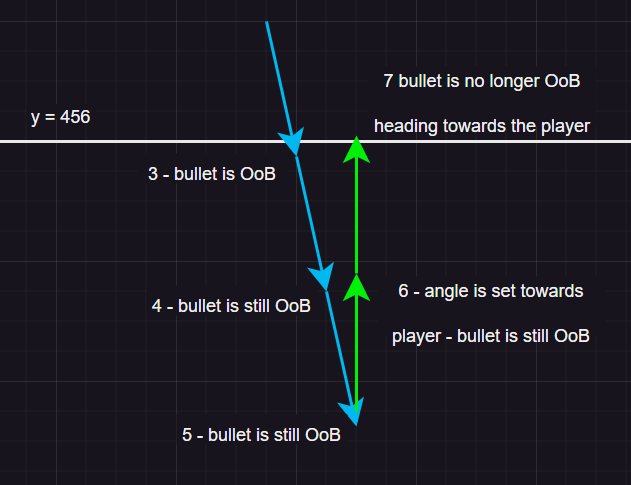
This diagram is more realistic as to what is happening in the initial image. The tip of the green arrow is barely above y = 456. If at step 3 the bullet was slightly farther away from y = 456, it would have meant that at step 7 the bullet is still OoB meaning it would have despawned.
This section has no content yet. Would you like to add to this section? Contact me if you are interested!

All Imperishable Night pages: | |
|---|---|
| Dialogue Pause Desync · Unintended Last Spell Trigger · Hourai Jewel Bounce · Stage 4 Boss Items Bug · The 2038 problem · CPU-dependent Desync | All Ecl-related pages: |